Key Takeaways
Is a UK ETA health declaration required in 2026? No. See what the application asks, why there are no vaccination questions and which health steps matter.
Worried about declaring a medical condition, vaccinations or COVID status when you apply? Here is the reassuring headline: a UK ETA health declaration simply does not exist. Britain’s Electronic Travel Authorisation never asks about your health. This guide explains exactly what the form does request, why medical questions play no part, and which genuine health steps still matter ahead of your trip to the UK.
TL;DR: No medical declaration is part of this scheme. The £20 application covers your identity plus a handful of suitability questions — not your medical history, vaccinations or COVID status. Britain sets no general vaccination entry requirement, yet travel insurance and a clear grasp of your NHS access rights remain strongly recommended.
| Quick Facts: Health Rules and the UK ETA | |
|---|---|
| Health declaration required? | No |
| Vaccination certificate needed? | No general requirement |
| What the ETA does ask | Identity plus suitability checks |
| Cost | £20 per applicant |
| Recommended instead | Travel insurance |
Does the UK ETA require a health declaration?
No — Britain’s ETA does not require a health declaration of any kind. Its application form asks nothing about medical conditions, disabilities, medication, vaccinations or COVID-19 status. This Electronic Travel Authorisation is a pre-travel security and identity check, and the questions it contains are confirmed in the official UK ETA guidance (the Home Office, current to 23 June 2026) — none of them concern your health.
This surprises many travellers because other systems blur the picture. During the pandemic, the UK briefly used passenger locator forms and health declarations, but those were separate emergency measures that ended in 2022. The ETA, launched for non-European nationals on 8 January 2025 and European nationals on 2 April 2025, has never included a health section.
What does the UK ETA actually ask instead of a health declaration?
Instead of a medical declaration, the application asks for your identity details and a short set of suitability questions about criminal history and security. You provide passport information, a photo and contact details, then answer questions designed to confirm you are not a security concern. No medical questionnaire appears at any point in the process.
Here is what the application covers:
- Passport and personal details, read electronically from your passport chip.
- A digital photo, required for every applicant including children.
- Suitability questions, mainly about serious criminal convictions — explained in our guide on UK ETA criminal record questions.
- A £20 fee, up from £16 on 8 April 2026 and from £10 on 9 April 2025 (UK ETA guidance, as of 23 June 2026).
If you answer the suitability questions honestly and your identity checks clear, most applications are approved within minutes, according to UK Visas and Immigration (checked 23 June 2026).

Important: Any website asking you to complete a “UK ETA health declaration” or upload medical or vaccination documents is not the official service. The genuine application at gov.uk never requests health information. Treat such requests as a red flag for a scam.
Are vaccinations required to enter the UK in 2026?
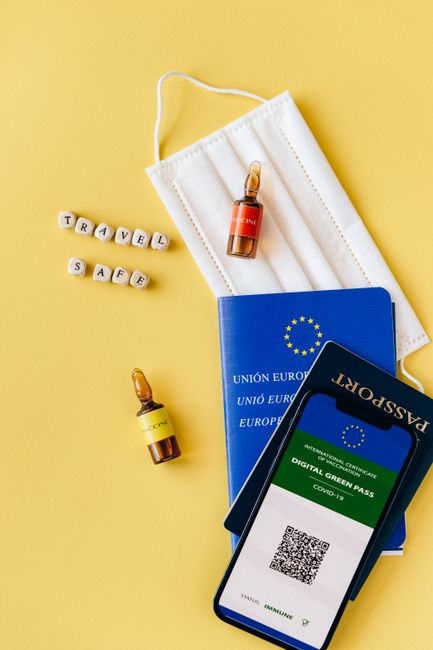
No — the UK has no general vaccination requirement for entry, so no vaccine certificate exists to declare on or alongside your ETA. Tourists, business visitors and most other travellers do not need to prove any immunisation to arrive in 2026. This has been the standard position since pandemic-era rules were removed, and it applies regardless of which country you travel from.
There are narrow public-health exceptions that can change at short notice during an outbreak, so it is sensible to check current advice before you fly. The NHS page for visitors to England and the NHS entitlements guidance set out the latest position (NHS guidance and the Home Office, June 2026). For routine trips, however, no vaccination declaration is needed for either the ETA or the border.
Why is there no health declaration in the UK ETA?
Britain’s ETA skips medical questions because the authorisation exists to screen for security and immigration risk, not public-health risk. Britain’s Home Office designed it as a fast, low-cost permission that mirrors systems like the US ESTA in scope. Health screening sits with separate NHS and public-health frameworks, which operate independently of the travel-authorisation process.
Keeping health out of the ETA also keeps the timeline short. Because the form only checks identity and suitability, the vast majority of decisions land within minutes rather than days. Adding a medical assessment would slow the system dramatically and duplicate protections that already exist at the UK border and within the health service, as outlined by UK Visas and Immigration.
What health steps should you take before travelling to the UK?
Although no medical declaration exists, you should still arrange travel insurance and understand your NHS access before you arrive. Visitors are not automatically entitled to free NHS care, and some treatments are charged at up to 150% of the standard cost for those without cover. Comprehensive travel insurance is therefore the single most important health step, as the government itself advises on its foreign travel insurance page (UK Home Office, the 23rd of June 2026).
Practical preparation includes:
- Buy travel insurance with medical cover before you depart — see our UK travel insurance guide for what to look for.
- Carry enough prescription medication for your trip, in original packaging with a copy of the prescription.
- Check your NHS entitlements using the official NHS healthcare for tourists guide so you know what is free and what is charged.
- Confirm you actually need an ETA for your nationality with the check if you need a UK visa tool.

UK ETA health declaration versus other travel systems
Unlike some travel programmes, the ETA carries no medical questionnaire, which makes it simpler than the COVID-era systems travellers may remember. The EU’s upcoming ETIAS and the US ESTA also focus on security rather than medical screening, so the absence of a health section is consistent with comparable schemes. Travellers moving between these systems sometimes expect a medical form that simply is not there.
One crucial takeaway: ignore any prompt for medical information during your application. Legitimate data collected by the ETA is limited to identity, a photo and suitability answers, all submitted through the official gov.uk service for the standard £20 fee. Everything health-related is handled separately, before you travel, through insurance and NHS guidance.

Does the no-health-declaration rule apply to children and older travellers?
Yes — the absence of any medical declaration applies to every traveller equally, including babies, children and older adults. No age group is asked about medical conditions, mobility, vaccinations or fitness to travel. Each person simply needs their own £20 ETA with a passport and photo, and the same identity and eligibility questions apply regardless of age.
This matters for families and for older visitors who might assume extra health paperwork is involved. It is not. A grandparent travelling with grandchildren completes exactly the same short application as everyone else, with no medical form to sign. The only age-related point worth noting is that travel insurance becomes more important — and sometimes more expensive — for older travellers, because NHS charges for visitors can be substantial without cover, as the NHS entitlements guidance makes clear (Britain’s Home Office).
Travellers with ongoing medical needs sometimes worry that declaring nothing could cause problems at the border. It will not. Border officers focus on immigration and security, not your health history, and you are under no expectation to volunteer medical information. Carrying a doctor’s note for any unusual medication is sensible for your own convenience, but it forms no part of the ETA or entry requirements.
Frequently asked questions about the UK ETA health declaration
Is there a UK ETA medical form to complete?
No. The ETA includes no medical questionnaire. It asks only for identity details, a photo and suitability questions about criminal and security history.
Do I need a COVID-19 vaccination or test for my ETA?
No. There is no COVID requirement linked to the ETA, and the UK has no general vaccination entry requirement in 2026.
Will a medical condition affect my ETA application?
No. Medical conditions are not part of the application and have no bearing on whether your ETA is approved.
A website asked for my vaccination certificate — is that official?
No. The official ETA service never requests health or vaccination documents. Such requests indicate a scam site.
If health is not checked, what should I prepare?
Arrange travel insurance with medical cover, carry your medication and check your NHS access rights ahead of departure.
In short, the medical declaration that many travellers expect simply does not exist. The application is a quick identity-and-suitability check costing £20, with no medical questions at all. Focus your health preparation where it counts — insurance and NHS access — and apply only through the official gov.uk service to stay safe from look-alike scam sites.
 English
  العربية
  বাংলা
বাংলা  Български
  Català
  简体中文
简体中文  Hrvatski
  Čeština
  Dansk
Dansk  Nederlands
  Eesti
Eesti  Suomi
Suomi  Français
  Deutsch
  Ελληνικά
  עִבְרִית
  हिन्दी
  Magyar
  Íslenska
  Bahasa Indonesia
  Italiano
  日本語
日本語  한국어
한국어  Latviešu valoda
  Lietuvių kalba
  Bahasa Melayu
  Norsk bokmål
  Polski
  Português
  Română
  Slovenčina
  Slovenščina
  Español
  Svenska
  Türkçe
  Tiếng Việt